
Italian Retirement Visa Requirements for Americans
No two consular checklists read exactly alike, but the categories of evidence rarely change. Understand the categories and the order, then build your file against your own consulate's list.
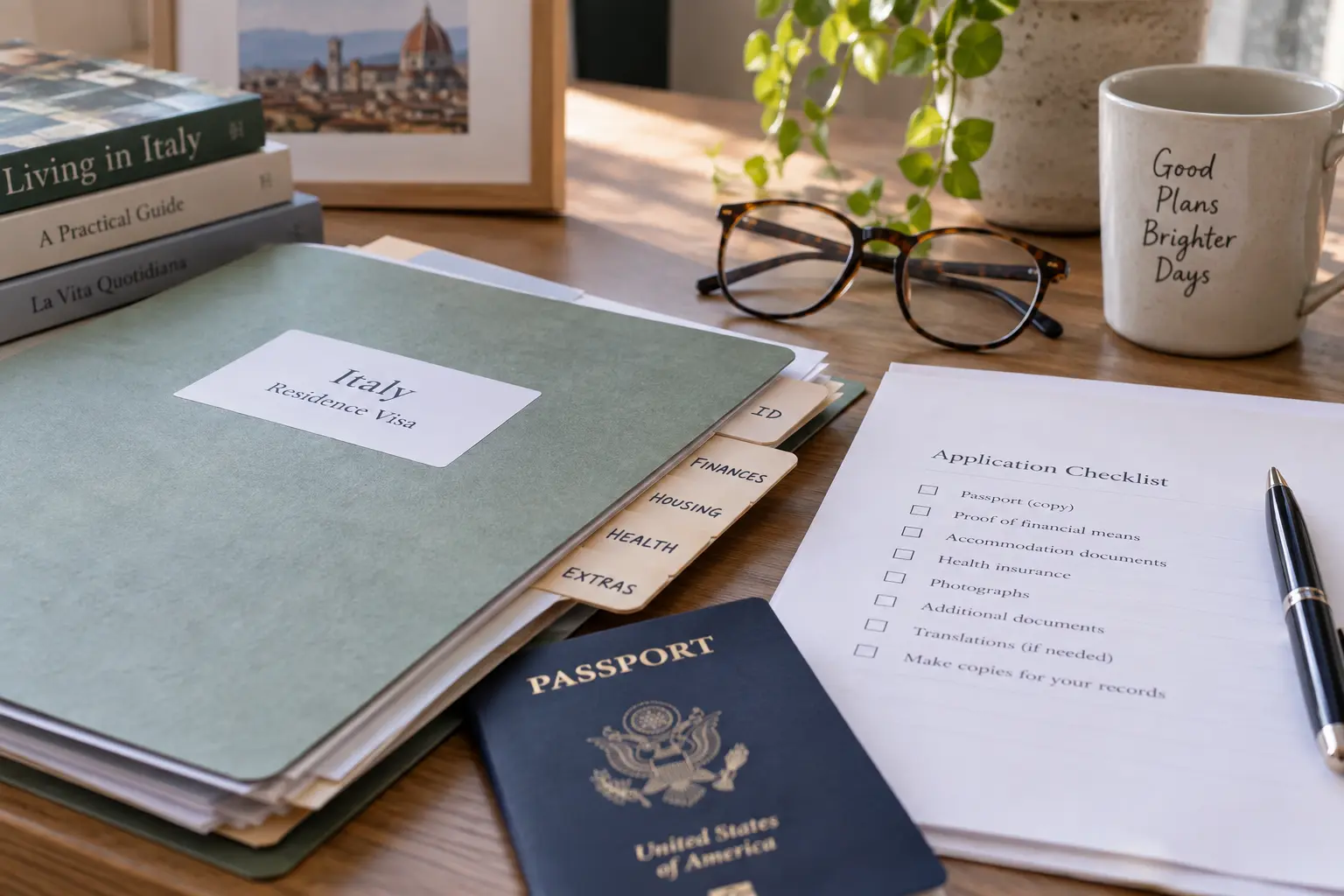
Quick answer: the key takeaways
- The consulate that serves your U.S. state of residence sets the checklist that governs your application. Treat its published list as the only authoritative one.
- Evidence generally falls into four groups: identity, passive income, accommodation in Italy, and health coverage.
- Translation and legalization take time and must usually happen in a particular order. Start with the documents that are slowest to obtain.
- Incomplete files are the most common cause of delay. Missing a single supporting document can mean waiting for a new appointment.
- Requirements and evidence standards change. Confirm everything directly with your consulate before you gather or pay for anything.
The four evidence categories
Almost everything on a consular checklist answers one of four questions: who you are, how you will support yourself without working, where you will live, and how your healthcare will be paid for.
| Category | The question it answers | Typical evidence |
|---|---|---|
| Identity and status | Who you are and whether you may apply here | Passport, application forms, photographs, proof of residence in the consular district |
| Passive income | Can you support yourself in Italy without working | Documentation of pensions, Social Security, retirement accounts, rental or investment income, plus supporting statements |
| Accommodation | Where in Italy you will actually live | A lease, a property deed, or other evidence of suitable housing |
| Health coverage | Who pays if you need care | A policy meeting the conditions your consulate specifies for the visa |
Consulates differ on how much of each they want, how recent it must be, and what form it takes. They do not generally differ on the categories themselves, which is why you can start assembling well before you have your appointment date.
Sequencing: what to start first
Some documents take an afternoon, others take months. Start with the slow ones, because the fast ones can be refreshed later if the consulate wants recent copies.
- Read your own consulate's checklist and note every stated format, recency, and certification requirement.
- Begin anything issued by a third party, such as records, certificates, or institutional letters.
- Arrange housing in Italy, since this is often the slowest item for people who have not yet chosen a town.
- Obtain any required certifications or legalization for documents that need them.
- Have translations prepared where required, after certification rather than before, if that is the order your consulate specifies.
- Assemble income documentation last, so it is as recent as possible on the day of your appointment.
- Book the appointment as early as the system allows, because availability, not paperwork, is often the binding constraint.
The accommodation problem
Applicants frequently get stuck here, because it feels circular: you are asked to show housing in a country you cannot yet move to. In practice people resolve it by securing a long term rental before applying, or by using property they already own.
This is the strongest practical argument for scouting properly before you apply. Signing a lease in a town you have only seen in August is a poor way to satisfy a document requirement.
After the visa is issued
The visa lets you enter Italy for long stay purposes. It is not the end of the process. After arrival you apply for a residence permit, obtain a tax code if you do not already have one, and register your residence locally, each with its own paperwork and timing.
Frequently asked questions
- Which Italian consulate handles my retirement visa application?
- Normally the consulate with jurisdiction over your U.S. state of residence. Jurisdictions are published by each consulate, and applying to the wrong office is a common reason applications are refused at the door.
- Do I need housing in Italy before applying for the visa?
- Consulates generally expect evidence of where you will live, such as a lease or a property you own. Confirm the exact standard your consulate applies before signing anything.
- How long does the Italian retirement visa process take?
- Plan in months rather than weeks. Appointment availability, document gathering, certification, and translation all add time, and processing after the appointment varies by consulate.
What to do next
- 1.Understand the visa itself
How the elective residence route works and who it suits.
- 2.Check income expectations
How consulates look at passive income, not just the headline figure.
- 3.Find your consulate
Jurisdiction by state and how to read a consular checklist.
Sources and references
We cite primary and official sources wherever possible. Requirements change, so treat these as starting points and confirm current details directly.
- 1.Consular visa checklistsItalian consulates in the United States. The governing requirement for your application. Check the office covering your state.
- 2.Italian visa information portalItalian Ministry of Foreign Affairs. National level guidance on long stay visa types.
Who wrote and reviewed this
Retiring in Italy Editorial TeamResearch and editorial
Placeholder byline. Our editorial team researches and drafts every guide, then sends legal, tax, and healthcare material for outside review before publication.
Placeholder profile. Named bylines appear here once contributors are attached.
Expert review pendingImmigration and residency review
Placeholder reviewer slot. This guide has not yet been reviewed by an independent Italian immigration professional. Reviewer names and credentials appear here once review is complete.
Newsletter
Get the Italy Retirement Checklist
One email at a time on visas, taxes, healthcare, housing, and places. Start with our planning checklist for Americans.